We’ve had a number of whale sighting, but this was the first “show”. Whales and waterfalls are the order of the day in this part of Alaska. We’re far from the glaciers. We did see a few “berggie bits” in Fredrick Sound as we left Petersburg.

On our way to Warm Springs on Baranof Island, (I threw in the name of the island, because I love the sound of it and it is one of the few I can pronounce.) we planned to spend the night at Cannery Cove: "a very secure anchorage". As we came into the bay with 15 knots of wind on our stern, we were greeted with 20 knots on our nose and whitecaps in the cove. The snow-covered mountains surrounding the cove contributed a temperature drop of about 10 degrees. ‘Not high on our list of attributes for a secure anchorage. We crossed Pybus Bay to Henry’s Arm. Don’t know what Henry did to lose his arm, but we appreciated the tiny, calm, warmer spot to dig in Mr. Delta, our well-loved anchor. We have learned not to place all of our bets on the advice in the cruising guides.
Warm Springs is a popular stop with natural hot springs. The day we came into the bay, the dock was full, there were about ten boats anchored in the (deep) bay. We decided to anchor in a tiny cove where we would need to tie the stern to a tree on shore. No, really. That is recommended procedure when you don’t have room for the boat to “swing” on her anchor. The cove proved to be smaller than was comfortable and we were in danger of drifting into one of the walls before we got the dinghy launched to secure the stern. ‘Too much excitement. We brought Mr. Delta back on board and motored out into the bay, headed toward the waterfall for a Photo Opportunity.

Warning: The following paragraph should not be read by people who get hives listening to other people’s minutiae or watching soap operas.
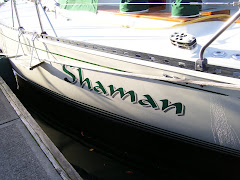
 As we came out of the tiny cove we heard “Shaman, this is Celerity. Over." on the VHF . It was Charlie and Wendy Wilcox, from Indianola aboard Celerity, another C&C sailboat, that had just entered the bay. Last spring we had been put in touch with them through mutual friends and said we would keep an eye open for each other. Their eyes were open! Celerity rafted up next to a sailboat on the dock and offered to let us raft outboard of them. No sooner had we tied up than Jim, Adirondack’s skipper (Misty Fiords and Meyer’s Chuck), came over with a piece of salmon that Brad from El Buccanero had given to him before they left, asking Jim to deliver it to us when we arrived. The sailboat that Celerity was rafted to, Majeck from Juneau, is a boat we met last summer in Taku Harbor. Her skipper told us how to get to Juneau without putting our 62’ mast under the 50 foot bridge. I’m not through. You were warned. Allergra, a 54-foot trawler we met last year at Bishops Bay Hot Springs was also on the dock with her wood-carver skipper. And then Ed McMann appeared out of the rain and told us we had won the Clearing House Sweepstakes. Okay, I made up the last part.

Bellingham purse seiners rafted behind us, waiting for a salmon opening in five days.

Doug, impersonating a Canadian Mountie and working on keeping his complexion moist. The falls were impressive and we walked up to….

....the natural hot springs where only this lone handsome male was bathing. Doug restrained me. Yes, those are raindrops on the water. In addition to this pool and two smaller ones below it, the community has built three small bathhouses.

This little guy got his picture taken because to me he represents the tenacity of the people, vegetation, and critters in Southeast; accepting the environment and finding their place to be nourished.

Fish Bay, Peril Strait on the way to Sitka. We anchored here on our way back. We anchored in Baby Bear Bay heading east. No Bears of any age or size in sight.

Mt. Edgecumbe, Sitka’s classic volcano…on the one SUNNY day!
We like Sitka! It has a fascinating history starting with the Tlingit Indians arriving here thousands of years ago. The Russians came in the late 1700’s in search of sea otter pelts, driving off the Tlingits and killing all the sea otters in an excellent imitation of that fine European and US tradition. Finally, when they couldn’t afford it anymore, the Russians sold the whole thing to us.
We like Sitka! It has a fascinating history starting with the Tlingit Indians arriving here thousands of years ago. The Russians came in the late 1700’s in search of sea otter pelts, driving off the Tlingits and killing all the sea otters in an excellent imitation of that fine European and US tradition. Finally, when they couldn’t afford it anymore, the Russians sold the whole thing to us.

Critters along Sitka’s waterfront walk to the Raptor Center, Sheldon Jackson Museum, and Sitka’s National Historic Park. I should have had my hat on the halibut’s head. The Public Radio station in Sitka is Raven Radio, with the call letters KCAW and a wonderful raven logo.
 Doug's new friend.
Sitka’s Raptor Center rehabilitates injured birds from all over the state. It was started in the ‘80’s by a couple that decided to rescue an injured eagle and it has grown into a well-financed facility.
Sitka’s National Historic Park is the oldest and smallest National Park in the state. It has two miles of trails with replicas of old totem poles and original poles inside the visitors’ center. We have at pictures them all.

The park is on the site of the second conflict between the Tlingits and the Russians in 1804, which the Russians won with the help of their Aleut conscripts. (That would be “slaves”, would it not?
Sitka’s National Historic Park is the oldest and smallest National Park in the state. It has two miles of trails with replicas of old totem poles and original poles inside the visitors’ center. We have at pictures them all.


The park is on the site of the second conflict between the Tlingits and the Russians in 1804, which the Russians won with the help of their Aleut conscripts. (That would be “slaves”, would it not?

In a shed outside the visitors’ center, as we investigated this totem-pole in-progress, we noticed the book The Blue Bear sitting on a shelf along with an announcement that the pole would be erected in Sitka in honor of Michio Hoshino. Michio was a Japanese photographer who photographed Alaska for most of his life and was killed by a brown bear in Russia. The Blue Bear is the story of Michio’s search for the Kermode bear, known at The Spirit Bear in Canada. Doug and I read the book two years ago and loved the story as well as the spirits of Michio and Lynn Schooler, the author.

We went inside the Visitors’ Center and met the carver, Tommy Joseph, who was commissioned to carve the pole by Michio’s family. He wanted to put Michio on the bottom of the pole, but Michio’s father objected, saying the figure should not represent one person. So Tommy put a camera lens in the figure’s hands and put Michio’s face in the blowhole of the whale. A bear is on top, to represent Michio’s unmet quest. At Tommy’s suggestion we bought The Only Kayak, another book by a friend of Michio’s, as well as Hoshino’s Alaska, one of the few books of Michio’s photographs with his essays in English. Michio’ family will be at the pole raising in Sitka on August 8th, the twelfth anniversary of his death.
 Investigating a medium-sized Southeast skunk cabbage. I wonder if it is the State Plant.
 Sitka's Russian cemetrary where we found mostly Scandinavian and Native names.
We took a boat ride! But you knews that. No, not on Shaman. On a tour boat. Oh. I forgot to tell you our Sitka Small-Southeast story! That leads to the tour boat. You else do you have to do?
In Sitka, we were moored across from a new trawler. The second day we were here, Doug saw the name: Hono (Her tender’s name is Lulu. Story will follow.) Hono was at Liberty Bay Marina, Shaman’s homeport this spring while her owner was outfitting her (brand new boat). Doug had chatted with the skipper a few times. We walked across the dock to introduce ourselves.
Sandy and Wade, Hono’s owners, live in Denver in the winter and work in Sitka in the summer. (He used to live on Bainbridge.) They just got their permanent moorage in Sitka after being on the waiting list for five year. They both work for Allen Tours in the summers on the tour boats that serve the cruise ships: Sandy as a naturalist and Wade as a skipper. They took this summer off to commission Hono and bring her north. They, of course, highly recommended that we take one of the “local tours” to go out to St. Larzia Island to see The Puffins! In addition to wanting to see Skagway, Haines, et al, I had wanted to see Puffins on this trip. We paid our money and took our chances.
I promised the maning of Hono’s name. (you were hoping I would forget?) “Hono” means “sea turtle” in Hawaiian (or maybe just “turtle”). Wade thought that since the boat is slow like a turtle and since she carries their home on her back, she resembled a turtle. And then the tender had to be Lulu. Why not?
In Sitka, we were moored across from a new trawler. The second day we were here, Doug saw the name: Hono (Her tender’s name is Lulu. Story will follow.) Hono was at Liberty Bay Marina, Shaman’s homeport this spring while her owner was outfitting her (brand new boat). Doug had chatted with the skipper a few times. We walked across the dock to introduce ourselves.
Sandy and Wade, Hono’s owners, live in Denver in the winter and work in Sitka in the summer. (He used to live on Bainbridge.) They just got their permanent moorage in Sitka after being on the waiting list for five year. They both work for Allen Tours in the summers on the tour boats that serve the cruise ships: Sandy as a naturalist and Wade as a skipper. They took this summer off to commission Hono and bring her north. They, of course, highly recommended that we take one of the “local tours” to go out to St. Larzia Island to see The Puffins! In addition to wanting to see Skagway, Haines, et al, I had wanted to see Puffins on this trip. We paid our money and took our chances.
I promised the maning of Hono’s name. (you were hoping I would forget?) “Hono” means “sea turtle” in Hawaiian (or maybe just “turtle”). Wade thought that since the boat is slow like a turtle and since she carries their home on her back, she resembled a turtle. And then the tender had to be Lulu. Why not?
Tour boat! We saw a raft of sea otters. We didn’t know their groupings were called rafts. One little guy was away from the raft, showing us exemplary sea otter behavior, up close and natural. No pictures. Well, one. Next ,the whales were doing their amazing whale thing. We sped out to St. Lazaria, fifteen miles off the coast, for the puffins and mures. It was well worth the price of admission.

 Sitka is home to many “firsts” in the 49th state, including the first “Pioneers’ Home”. In the early 1900’s (long before Alaska was a state), a compassionate group of people realized that something should to be done for the ageing prospector population and were able to procure this handsome Marine Corps facility. That is not a soldier in front. It is some poor soul on a quest. Alaska takes care of its own.
In Petersburg, we saw bumper stickers supporting one side of a current economic issue: Friends Don’t Let Friends Eat Farmed Salmon. This is not a local issue. We’ve seen the same bumper stickers on Bainbridge. However, in a town where fishing is the only industry, the issue is intensified. In Sitka we saw this bumper sticker…

The commercial fishing industry has been regulated for many years, with allocations carefully calculated to keep the resource alive. In the past few years, the sports fishing charter companies have become an industry, and the resource is being impacted. Until very recently, this impact has not been acknowledged. The frustrated commercial fishers were in the untenably position of not being allowed to fish (because there was not an opening) but the sports fishing boats were peeling out of the harbors, taking advantage of extremely liberal halibut limits. (Salmon have long been carefully regulated for both sports and commercial fishers.)

We left Sitka, headed back though Peril Strait. We have all of the charts to go either north or south from Sitka on the outside (that would be the Pacific Ocean side), but the prudent mariner only does that if the weather is “settled”. Our weather has been settled: Rain and Wind. Probably not what Sailing Directions had in mind.

No comments:
Post a Comment