Chronicle 3
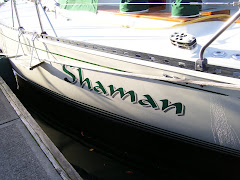
June 1 We’ve never anchored three times in one day. Shaman transited Dent Rapids at 8:30 in the morning, Green Point Rapids at 3:30 and Whirlpool Rapids at 8:30 at night. Between each slack water, we had to anchor to wait for the next tidal exchange. When we stopped near Green Point to decide where to wait for slack water, Shaman went backwards at two knots, then circled 180 degrees in the current and was “underway with no way on” at three knots, playing in the little whirlpools and back eddies. We put her in gear, turned her around, and found a calm spot for lunch. Our final anchorage was Douglas Bay, (only two miles from Whirlpool) where we anchored last year in the company of Herself. Shaman was disappointed not to find her friend there. Tomorrow we head for the Johnston Straits.
June 2
Are there supposed to be whitecaps in the anchorage?
I’m not going to write any more. I’m not having fun.
June 3 Okay. I’m back. The whitecaps were in Burial Cove. What would you expect with a name like that? BAD WEATHER was predicated when we departed Douglas Bay. We checked out three anchorages off the Johnstone Straits, settling on Burial Cove because it appeared to be most protected from easterly winds. Looks can be deceiving. However, the weather gods were kind, and the 15-20 knot winds died down before dark, allowing us to sleep without the depth sounder and knot meter on.
June 5 Our third day at Port McNeill. We like Port McNeill, but a three days is excessive. One yacht left early yesterday morning and made it around Cape Caution. Another left an hour later and had to turn back because of the wind and high seas. We set our alarm for 4:30 this morning, listened to the weather, and went back to sleep. I’m sure everyone else at the docks did the same. Our destination is more about 40 miles from here, (that means six to eight hours) so we need a big weather window. Maybe tomorrow.
Cruising Terminology: How do you know if you are looking at a yacht or simply a very large expensive boat? Questions like this come to mind when you are trying to pass the time in The Rain. Darlene and Brad had the answer. A yacht has two radomes, not one. This is helpful information since we are seeing many yachts and very large expensive boats. Their skippers don’t keep track of the price of diesel fuel.
June 1 We’ve never anchored three times in one day. Shaman transited Dent Rapids at 8:30 in the morning, Green Point Rapids at 3:30 and Whirlpool Rapids at 8:30 at night. Between each slack water, we had to anchor to wait for the next tidal exchange. When we stopped near Green Point to decide where to wait for slack water, Shaman went backwards at two knots, then circled 180 degrees in the current and was “underway with no way on” at three knots, playing in the little whirlpools and back eddies. We put her in gear, turned her around, and found a calm spot for lunch. Our final anchorage was Douglas Bay, (only two miles from Whirlpool) where we anchored last year in the company of Herself. Shaman was disappointed not to find her friend there. Tomorrow we head for the Johnston Straits.
June 2
Are there supposed to be whitecaps in the anchorage?
I’m not going to write any more. I’m not having fun.
June 3 Okay. I’m back. The whitecaps were in Burial Cove. What would you expect with a name like that? BAD WEATHER was predicated when we departed Douglas Bay. We checked out three anchorages off the Johnstone Straits, settling on Burial Cove because it appeared to be most protected from easterly winds. Looks can be deceiving. However, the weather gods were kind, and the 15-20 knot winds died down before dark, allowing us to sleep without the depth sounder and knot meter on.
June 5 Our third day at Port McNeill. We like Port McNeill, but a three days is excessive. One yacht left early yesterday morning and made it around Cape Caution. Another left an hour later and had to turn back because of the wind and high seas. We set our alarm for 4:30 this morning, listened to the weather, and went back to sleep. I’m sure everyone else at the docks did the same. Our destination is more about 40 miles from here, (that means six to eight hours) so we need a big weather window. Maybe tomorrow.
Cruising Terminology: How do you know if you are looking at a yacht or simply a very large expensive boat? Questions like this come to mind when you are trying to pass the time in The Rain. Darlene and Brad had the answer. A yacht has two radomes, not one. This is helpful information since we are seeing many yachts and very large expensive boats. Their skippers don’t keep track of the price of diesel fuel.
 School bus taking middle school track team back to Malcolm Island. Yes, the dog came with the team.
 Bus to Alert Bay
We were mussing and fussing on the boat yesterday when we heard a VERY LOUD NOISE coming from somewhere inside the boat. I was below and started looking for a source, starting with the bilge. Doug was checking on deck. It sounded like water rushing, but we don’t have a three-foot diameter through-hull fitting. Doug’s description: a huge hole saw. It stopped when we turned off the switch to the 110-shore power. We stared at each other in disbelief. We’ve got a BIG problem. How do you start trouble-shooting that one???
I stuck my head out the companionway and saw people gathered on the dock, talking about “noise”. I trotted over and joined their conversation. What do you suppose it was? Did you see everyone dive to check out their bilges? It had happened twice earlier in the day while we were on shore. Our shore power switch and the sound ceasing were purely coincidental. We never did figure it out. The ferry to Alert Bay comes in on the other side of the breakwater, so that was probably the source. ‘Haven’t heard it again, but it did get us together to exchange weather complaints.
I stuck my head out the companionway and saw people gathered on the dock, talking about “noise”. I trotted over and joined their conversation. What do you suppose it was? Did you see everyone dive to check out their bilges? It had happened twice earlier in the day while we were on shore. Our shore power switch and the sound ceasing were purely coincidental. We never did figure it out. The ferry to Alert Bay comes in on the other side of the breakwater, so that was probably the source. ‘Haven’t heard it again, but it did get us together to exchange weather complaints.
 What to do in The Rain on your third day at Port McNeill
 Jean looking for a new home.
June 6 Yet another day at lovely Port McNeill. The gale force southeasterly winds abated and then switched to gale force northeasterly. We took the ferry to Alert Bay with Darlene and Brad from San Diego. Photos tell the story.
 Port McNeill boat harbor. Shaman is not visible, but we know she is there.
 All aboard for Alert Bay, Cormorant Island.


 ‘Gators here?
 That be airplane parts to the left of the red building. We created a story.


 Former St. Michael’s Residential School in use until the 1970’s. The residents of Alert Bay have elected to keep it as part of their history. We talked to a man in his ‘70’s who lived on Village Island (a small island across the Johnston Straits) as a young boy. When he was old enough to go to school, his family moved to Alert Bay so that he would not have to be separated from them.
 G00d idea.
 We followed the sign and met Bruce Alfred who specialized in steam-bent boxes and chests; his workshop is in the basement of the former school building. He is currently working with groups of school children to introduce them to carving skills and just received the BC Creative Achievement Award for Aboriginal Art. (We saw the article in the local newspaper.)
 U’mista Cultural Center adjacent to the former school building
Potlatches were outlawed in Canada in 1884. In 1921 forty-five people were charged with taking part in a potlatch and all of their coppers, masks, rattle, and whistles were confiscated and distributed among museums and private collections thought out North America. The Band has been working for years to repatriate the articles, and opened this Cultural Center in the 1980’s to display what the government and individuals have returned to them. They have a video with interviews with many Band members as well as part of the dedication ceremony. All of the masks and other articles are displayed (no cases because the people felt they needed to be free) along with correspondence among various government officials that would be laughable if it had not been so damaging.


 Alert Bay fades into the distance and we head back to 22-knot winds at the boat harbor and an early departure for Alison Harbor in the morning if the wind gods are willing.
 Port McNeill boat harbor. Shaman is not visible, but we know she is there.
 All aboard for Alert Bay, Cormorant Island.
Darlene and Doug in front of Arch welcoming us to Alert Bay. The figure in the middle is a human; you can tell by the hands. The identical animals on each end (are those bears?) looking in different directions represent holding or accepting the opposite forces of life. The curlies on the head of the human show that this is representing his spirit, not an actual person. According to the gentleman who explained this to me, the First Nations people's lives are all about transformation, and this carving represents the ultimate human condition, with life forces in perfect balance.

Van belonging to the First Mate on the ferry. His grandkids had painted it for him. Cute, eh? He’s the one who told me about the meaning of the carvings on the arch.

Old ‘Namgis Burial Grounds You were not allowed to walk on the grounds because when the totems fall, they are allowed to rot, no repairs are done; therefore, you could unknowingly be walking on a gravesite.

Darlene and I studying map of The Gator Gardens, a bog on the top of a hill with a bizarre origin (haphazardly man-caused). In the 1880’s the owners of a fish slatery changed their operation to a fish cannery. They build a dam halfway down the hill to store fresh water for the cannery; within five years, all of the trees died as a result of the flooding. In the 1920’s the trees caught fire (children and a community celebration were involved) and the community had to call in planes to drop water to extinguish the flames.
It got its name because it looks like a place that might have gators. They now call it an Ecological Preserve, but don’t you think the original name is better?
It got its name because it looks like a place that might have gators. They now call it an Ecological Preserve, but don’t you think the original name is better?
 ‘Gators here?
 That be airplane parts to the left of the red building. We created a story.
Chain saws are allowed.

You can create your own story.
 Former St. Michael’s Residential School in use until the 1970’s. The residents of Alert Bay have elected to keep it as part of their history. We talked to a man in his ‘70’s who lived on Village Island (a small island across the Johnston Straits) as a young boy. When he was old enough to go to school, his family moved to Alert Bay so that he would not have to be separated from them.
 G00d idea.
 We followed the sign and met Bruce Alfred who specialized in steam-bent boxes and chests; his workshop is in the basement of the former school building. He is currently working with groups of school children to introduce them to carving skills and just received the BC Creative Achievement Award for Aboriginal Art. (We saw the article in the local newspaper.)
 U’mista Cultural Center adjacent to the former school building
Potlatches were outlawed in Canada in 1884. In 1921 forty-five people were charged with taking part in a potlatch and all of their coppers, masks, rattle, and whistles were confiscated and distributed among museums and private collections thought out North America. The Band has been working for years to repatriate the articles, and opened this Cultural Center in the 1980’s to display what the government and individuals have returned to them. They have a video with interviews with many Band members as well as part of the dedication ceremony. All of the masks and other articles are displayed (no cases because the people felt they needed to be free) along with correspondence among various government officials that would be laughable if it had not been so damaging.

In the early days, people were sometimes taken captive by raiding parties. When they returned to their homes, either through payment of ransom or by a retaliatory raid, they were said to have u’mista. The return of the treasures from distant museums is a form of u’mista.

“World’s Tallest Totem Pole” How tall is it?, you ask. We’re not sure. From the brochure: It is comprised of a 163 for and a 10-foot pole, making it 173 feet tall. During the Nimpkish wind in November 2007 the top of the totem pole fell to the ground. We don’t know how tall it is. Taller than Doug.

New burial grounds…1970’s to present
 Alert Bay fades into the distance and we head back to 22-knot winds at the boat harbor and an early departure for Alison Harbor in the morning if the wind gods are willing.